This week has been one of those "Let's try every process under the sun" kind of weeks. Monday was egg albumen, Tuesday was negative diazo, Wednesday was Dolphin litho transfer paper, Thursday was crayon making, and Friday was caran d'ache. Friday was a short day and we took a trip to Rodney's house for dinner and a chance to relax.


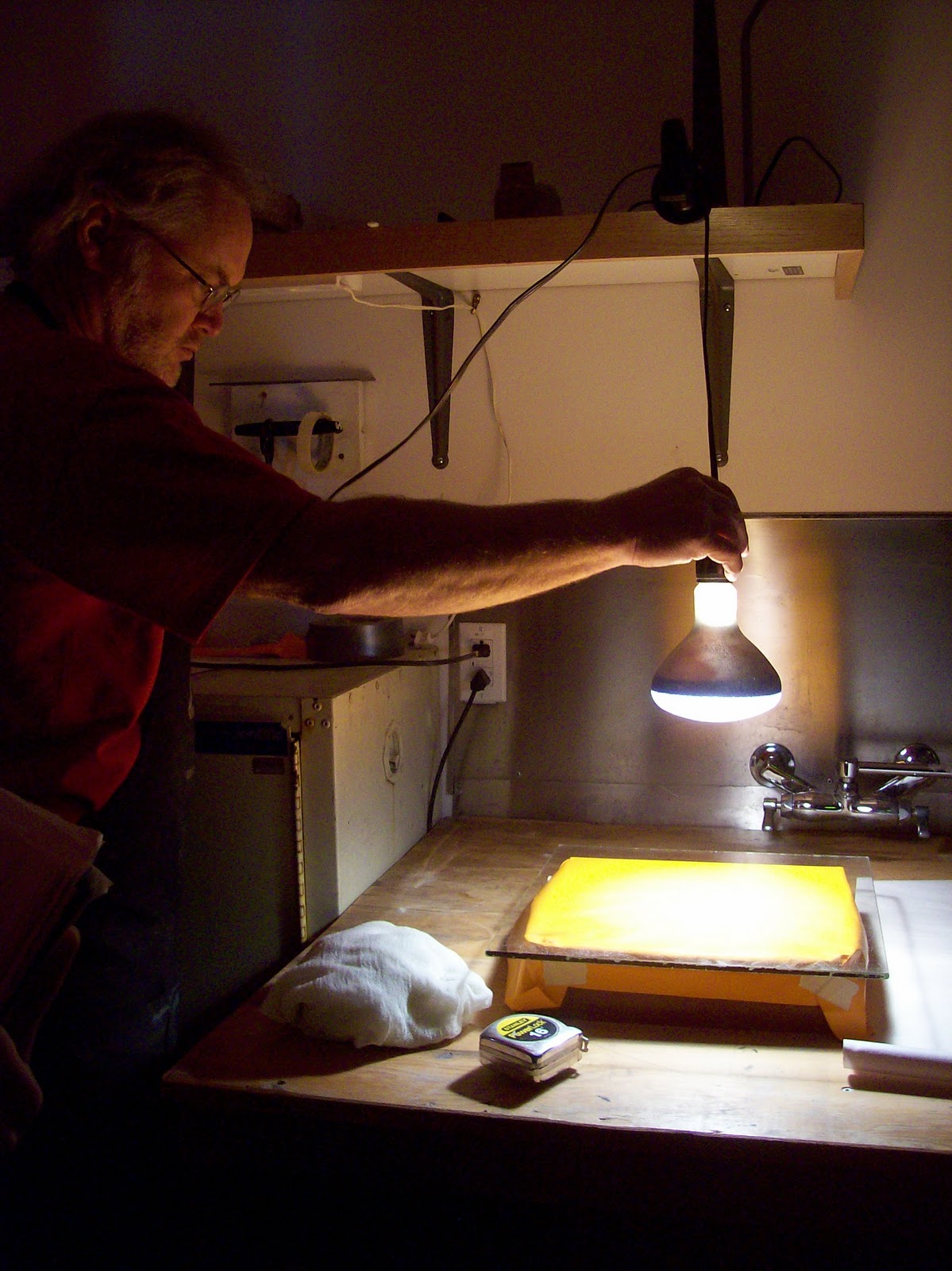
So... Monday! Both egg albumen and negative diazo are negative printing techniques where a negative is exposed over an emulsion base. The negative is then exposed to light and any area not covered become black. Egg albumen utilizes strained egg whites mixed with ammonium dichromate and coated on a stone as a base. Exposure can be done either out in the sunlight (for approximately 1 minute) or under a grow light (pictured) for anywhere from 10-15 minutes depending on the temperature, the thickness of the negative being exposed, the thickness of the egg coating, the strength of the bulb, etc. etc. Basically, there's a lot of variables to consider, and the failure rate is... above average.
My first attempt failed. I had used two negatives and aligned them to make the toner thick enough and I think the tape at the sides made the negatives buckle, hence the dark/burned spots in the image. Luckily, the egg comes off easily, so back to the graining sink and time to try again. Luckily attempt number two was a success.
Attempt 1= Boo.
Attempt 2= Hooray!
Negative diazo was similar in theory to egg albumen. Diazo coats a plate, a negative is exposed to light, and turns white areas black. The result was a nicer resolution than egg albumen, but sadly the materials are no longer available.
Rodney with the diazo on the plate (left) and the egg albumen on the stone (right).
My classmate Richard's diazo plate.
Wednesday brought with it Dolphin litho transfer paper. Transfer paper was originally used in the early days for en plein air drawings. An artist could easily transport a sheet of transfer paper, do a sketch on site, and return to the studio to transfer the image to a stone. Because there is a loss of detail from the transfer paper to the printing matrix (plate or stone) it often has to be reworked or added to. Transfer paper has a type of emulsion on the surface of the paper that, when dampened becomes tacky and releases, kind of like a temporary tattoo. The emulsion dries for a few minutes after transfer and then is gently wiped away, leaving only the drawing material.
Rodney with his awesome transfer of Santa Claus and Mr. Potato Head riding a convertible in the forest. :)
The start of my own drawing on transfer paper.
Everything was going smoothly until I decided to try a gum stop out over my crayon drawing to protect against solvent washes- I didn't want the washes to bleed into the crayon. Unfortunately when I transferred the paper to my stone the gum lifted out all the crayon it had been protecting and left me with a big ol' splotchy mess. A little counteretching and subsequent crayon work and I had a useable image again.
The transfer on the stone after reworking.
Undoubtedly the highlight of demo week was crayon making. Fumes, chemicals and fire filled the air as we melted together ingredients to make our own crayons. A local artist also lent us his crayon molds, so the final product looked incredibly legitimate too.
Rodney mixing together the ingredients.
Richard brought in a bag of old crayons to melt down as well.
Pouring the concoction into the molds.

Finally Friday and a demo on caran d'ache. Caran d'ache is a method where a water soluble substance is drawn onto a plate or stone, asphaltum is buffed in, and water lifts up the drawing material, leaving wherever you've drawn white, while the rest rolls up black. However, the demo didn't go according to plan. Early in the semester I had a strange plate that developed "frog skin" for no apparent reason. That is, the plate speckled, and speckled bad. I ran my edition and pawned off the rest of the unused plate on Rodney so he could use it for demos.
He used it for this demo.
It didn't work.
We all had what Rodney referred to as "Leavingitis" and decided it was a bad idea to do a demo when we were heading to his house so soon, instead we abandoned caran d'ache for spaghetti and meatballs.


 In between projects we still have a few demos from Rodney. Our first was on the huge Steinmesse & Stollberg (S&S) flatbed press. Rodney had us pulling flats one day, and mono-prints the next day. The whole experience was pretty cool. That press is gigantic, and a little intimidating, but very impressive. We've yet to fire it up and run it automatically, but Rodney tells us it's loud and awesome.